Blog

  • The Rise of AI-Generated Art: Exploring the Creative and Ethical Implications of Artificial Intelligence Art

    The Rise of AI-Generated Art: Exploring the Creative and Ethical Implications of Artificial Intelligence Art

    Introduction to the Fascinating World of AI-Generated Art

    The emergence of AI-generated art has sparked intense debate and fascination among art enthusiasts, technologists, and the general public. This phenomenon raises fundamental questions about the nature of creativity, the role of human imagination, and the future of art itself. As we delve into the world of AI-generated art, we will explore what it is, how it affects our everyday lives, and the ethical implications that come with it. The AI art market is growing rapidly, with new AI art tools and software being developed to cater to the increasing demand for digital art AI.

    Understanding AI-Generated Art: A Simple Explanation

    Understanding AI-Generated Art: A Simple Explanation

    So, how does AI generate art? In simple terms, AI-generated art uses artificial intelligence algorithms to create unique pieces of art. These algorithms can be fed with vast amounts of data, including images, styles, and techniques, which the AI system then uses to generate new art pieces. The process involves complex computations and neural networks that mimic human-like creativity. AI art creation has become more accessible with the development of AI-generated art software for beginners, making it possible for anyone to try their hand at creating digital art AI.

    The Impact of AI-Generated Art on Everyday Life and Work

    The benefits of AI-generated art are numerous. It can automate repetitive tasks, enhance human creativity, and even create new forms of art that were previously unimaginable. However, AI-generated art is also controversial, raising questions about authorship, ownership, and the potential displacement of human artists. The ethical implications of AI-generated art are complex and multifaceted, requiring careful consideration and discussion. As the AI art market trends UK continue to evolve, it’s essential to address these concerns and ensure that the development of AI-generated art aligns with human values and principles.


    The Impact of AI-Generated Art on Everyday Life and Work
    Exploring the Creative Possibilities of AI-Generated Art

    Exploring the Creative Possibilities of AI-Generated Art

    Can AI create original art? The answer is yes, but with some caveats. While AI systems can generate novel and innovative art pieces, they are still based on the data and algorithms used to create them. Should AI-generated art be considered real art? This question sparks intense debate, with some arguing that AI-generated art lacks the human touch and emotional depth that defines traditional art. Nevertheless, AI-generated art is undoubtedly changing the creative landscape, and its potential to enhance human imagination and innovation is vast. To try your hand at creating AI-generated art online, you can use various AI art tools and software available, such as those designed for small businesses or individuals.

    Embracing the Future of Creativity with AI-Generated Art

    Is AI-generated art the future of creativity? While it’s difficult to predict the exact trajectory of AI-generated art, it’s clear that it will play a significant role in shaping the future of art and creativity. As a forward-thinking digital agency, Webygraphy is excited to explore the possibilities of AI-generated art and its applications in various fields. If you’re interested in learning more about AI-generated art or want to discuss how it can benefit your business, visit webygraphy.co.uk to discover the latest trends and innovations in digital art AI and the AI art market.

    Frequently Asked Questions

    How does AI generate art?

    AI generates art using artificial intelligence algorithms that are fed with vast amounts of data, including images, styles, and techniques. These algorithms then use the data to generate new art pieces. The process involves complex computations and analysis of the input data to produce unique art pieces.

    What are the benefits of AI-generated art?

    The benefits of AI-generated art are numerous, including automating repetitive tasks and enhancing human creativity. AI-generated art can also create new forms of art that were previously unimaginable, opening up new possibilities for artists and designers. This can be seen in the work of forward-thinking digital agencies like Webygraphy.

    Why is AI-generated art controversial?

    AI-generated art is controversial because it raises questions about authorship, ownership, and the potential displacement of human artists. There are also concerns about the lack of human touch and emotion in AI-generated art, which can make it seem less authentic or valuable than traditional art.

    Can AI create original art?

    AI can create original art, but with some caveats, as it is still based on the data and algorithms used to create it. While AI systems can generate novel and innovative art pieces, they are limited by their programming and input data. However, this does not mean that AI-generated art cannot be valuable or meaningful.

    Should AI-generated art be considered real art?

    The question of whether AI-generated art should be considered real art sparks intense debate, with some arguing that it lacks the human touch and emotion of traditional art. Others see AI-generated art as a new and exciting form of creative expression that deserves recognition and appreciation. Webygraphy, a digital agency at webygraphy.co.uk, is exploring the possibilities of AI-generated art and its potential impact on the art world.

    Is AI-generated art the future of creativity?

    AI-generated art will play a significant role in shaping the future of art and creativity, although it’s difficult to predict the exact trajectory. As AI technology continues to evolve and improve, we can expect to see new and innovative forms of AI-generated art that push the boundaries of what is possible. Webygraphy is excited to be at the forefront of this development and to see where AI-generated art will take us.
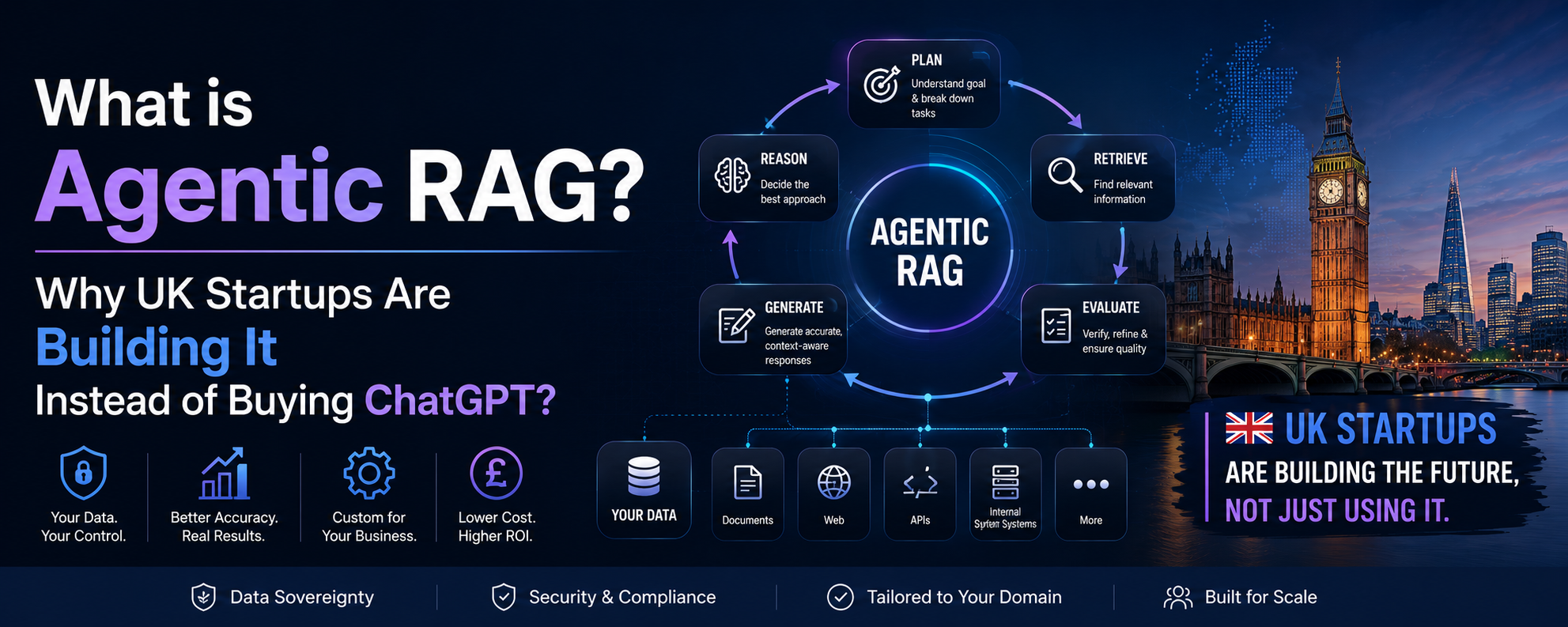


  • What is Agentic RAG? Why UK Startups Are Building It Instead of Buying ChatGPT

    What is Agentic RAG? Why UK Startups Are Building It Instead of Buying ChatGPT

    The Problem: Your AI Doesn’t Know Your Business

    You’ve tried ChatGPT. Maybe you’ve even paid for the API. And it’s impressive — until it confidently tells a customer the wrong return policy, invents a product feature that doesn’t exist, or quotes a pricing tier you
    discontinued eight months ago.

    This isn’t a bug. It’s a fundamental limitation.

    Large language models like GPT-4 are trained on data with a knowledge cutoff. They have no idea what’s in your internal wiki, your support docs, your pricing spreadsheet, or last quarter’s case studies. When they don’t know
    something, they don’t say “I don’t know” — they generate a plausible-sounding answer. That’s hallucination, and in a business context, it’s a liability.

    The solution isn’t a better prompt. It’s a different architecture. That architecture is called RAG — and when you add an agentic layer on top, it becomes one of the most powerful tools a UK startup can deploy right now.

    What Is RAG? (The Plain-English Version)

    RAG stands for Retrieval-Augmented Generation. Before the AI generates any response, it first retrieves relevant information from your own knowledge base — your documents, your database, your product data — and uses that as
    context.

    Think of it like this: instead of asking a smart stranger what your refund policy is, you hand them your actual policy document and ask them to explain it. The answer is grounded in real, current, company-specific information —
    not a best guess.

    The retrieval step works by converting your documents into vector embeddings, storing them in a vector database, and at query time finding the chunks most semantically similar to the user’s question. Those chunks are handed to
    the LLM alongside the question, and the LLM synthesises a coherent, accurate response.

    What Does “Agentic” Add?

    Standard RAG is a single retrieval step. Agentic RAG reasons about what to retrieve, decides whether the first retrieval was sufficient, and chains multiple retrieval and reasoning steps autonomously before responding:

    • Breaks down complex multi-part questions and retrieves different sources for each
    • Reformulates search queries if confidence is low
    • Cross-references multiple knowledge bases (product catalogue + pricing doc)
    • Calls external tools — APIs, databases, calendars — not just static documents

    Three UK SME Use Cases — With Real Numbers

    Customer Support — £4,200/month saved

    58% of tickets resolved without human touch. Resolution time for escalated tickets: 47 min → 19 min.

    Employee Onboarding — 3 weeks → 11 days

    Senior staff interruptions for process questions fell 71%. System flagged 23 outdated documents as a side benefit.

    Finance & Compliance Q&A — 2.3 hrs → 14 minutes

    Zero compliance errors in six months post-deployment. Full audit trail via citation logging.

    Cost and Timeline for Building Agentic RAG

    The cost of building an Agentic RAG system depends on the complexity of the workflows, the number of data sources, integration requirements, and the level of production readiness needed.

    ScopeEstimated CostEstimated Timeline
    Minimal viable RAG£8,000 – £15,0003 – 5 weeks
    Production agentic RAG£25,000 – £60,0008 – 16 weeks
    Monthly operations, API and hosting£200 – £800 per monthOngoing

    A minimal viable RAG system is usually suitable for testing the concept, validating business use cases, and building an internal prototype. A production-grade agentic RAG system requires more advanced planning, including workflow orchestration, security controls, monitoring, evaluation, guardrails, integrations, and ongoing optimisation.

    Monthly operational costs typically include LLM API usage, vector database hosting, cloud infrastructure, monitoring tools, storage, and maintenance.

    Common Mistakes to Avoid When Building a RAG System

    Building a RAG system can deliver strong business value, but only when the architecture is designed carefully. Many projects fail not because the LLM is weak, but because the retrieval layer, data pipeline, or governance model is poorly planned.

    1. Poor Chunking

    Naive document splitting can destroy context. If chunks are too small, the system may miss important meaning. If they are too large, retrieval becomes noisy and less accurate. A good RAG system needs chunking that matches the structure of the source content.

    2. Skipping Retrieval Evaluation

    Do not only test the final LLM answer. The retriever should be evaluated separately to check whether it is finding the right documents, sections, and evidence before the answer is generated.

    3. No Low-Confidence Handling

    A RAG system should know when not to answer. When confidence is low or the retrieved context is weak, it is better to say “I don’t have enough information” than to generate a misleading response.

    4. Ignoring Data Freshness

    Outdated data can lead to incorrect answers. Ingestion pipelines should be planned from day one so that documents, policies, product data, or internal knowledge bases remain current.

    5. Over-Engineering Too Early

    Adding agentic workflows before validating retrieval can make the system more complex without improving quality. Bad retrieval combined with agentic complexity usually means faster hallucination, not better automation.

    6. Underestimating Access Control

    Business RAG systems often need role-based filtering, department-level permissions, and secure document access. Access control should be designed early, not added later as an afterthought.

    Thinking About Building a RAG System for Your Business?

    Book a free discovery call with Webygraphy. We will help you understand whether RAG is the right fit for your business, what type of system you actually need, and how to avoid unnecessary cost or complexity.

    Frequently Asked Questions

    Q: What is agentic RAG?
    An AI system that autonomously decides what to retrieve, from where, and how many times — before generating a grounded response. Chains multiple retrievals and tool calls unlike standard single-step RAG.

    Q: What is the difference between RAG and ChatGPT?
    ChatGPT has no access to your internal data. RAG connects the AI to your own knowledge base so every answer is grounded in your actual documents, not a public training cutoff.

    Q: What is the difference between RAG and agentic RAG?
    Standard RAG = one retrieval + one response. Agentic RAG = autonomous multi-step reasoning — reformulates queries, cross-references sources, calls APIs — before responding.

    Q: How much does a RAG system cost in the UK?
    £8k–£15k for a minimal build (3–5 weeks). £25k–£60k for production agentic RAG (8–16 weeks). £200–£800/month ongoing ops.

    Q: How long does it take to build?
    2–3 weeks for a proof of concept. 8–16 weeks for production. Biggest variable: data quality.

    Q: Is RAG better than fine-tuning?
    For business use cases, yes. RAG retrieves from a live knowledge base (instant updates, citable sources). Fine-tuning bakes knowledge into weights — expensive to retrain and can’t cite sources.

    Q: Can small businesses use agentic RAG?
    Yes. UK SMEs with 10–50 employees are already using it for support, onboarding, and compliance.

    Q: What data can a RAG system use?
    PDFs, Notion, Confluence, Google Docs, Slack, CRM notes, product catalogues, databases — almost any text-based source.

    Q: What is AEO and why does it matter?
    Answer Engine Optimisation — structuring content so Google SGE, Bing Copilot, and voice assistants surface and cite it directly. FAQs are the core building block.

    Q: How do I know if RAG is right for my business?
    If accuracy matters, you have proprietary internal data, or off-the-shelf AI keeps hallucinating about your products/policies — RAG is likely the right fit.

  • Revolutionizing Workplace Productivity: The Future of Work with AI-Powered Tools

    Revolutionizing Workplace Productivity: The Future of Work with AI-Powered Tools

    What’s the Big Deal About AI in the Workplace?

    The future of work is undergoing a significant transformation, driven by the increasing adoption of AI-powered tools like Salesforce’s Slackbot and Anthropic’s Cowork. These innovative solutions are revolutionizing workplace productivity and collaboration, enabling businesses to streamline processes, enhance communication, and boost efficiency. As we explore the potential of AI in the workplace, it’s essential to understand how these tools can improve our daily work lives and what benefits they offer. With the rise of AI collaboration software, businesses can now leverage the power of artificial intelligence to automate repetitive tasks, provide personalized support, and facilitate seamless communication among team members.

    How Do AI-Powered Tools Like Salesforce Slackbot and Anthropic Cowork Work?

    How Do AI-Powered Tools Like Salesforce Slackbot and Anthropic Cowork Work?

    Salesforce Slackbot and Anthropic Cowork are prime examples of AI-powered collaboration tools designed to enhance workplace productivity. Slackbot, for instance, uses machine learning algorithms to automate tasks, provide real-time support, and offer personalized recommendations to users. Anthropic Cowork, on the other hand, focuses on facilitating seamless communication and collaboration among team members through its AI-driven interface. By integrating these tools into their workflow, businesses can experience significant improvements in productivity, reduced manual errors, and enhanced employee satisfaction. AI in the workplace is no longer a futuristic concept; it’s a reality that’s transforming the way we work. For small businesses, AI-powered collaboration tools like Salesforce Slackbot can be a game-changer, helping them stay competitive in the market and improve their overall efficiency.

    The Impact of AI-Powered Tools on Everyday Work Life

    So, how does AI improve workplace productivity? The answer lies in its ability to automate repetitive tasks, provide personalized support, and facilitate seamless communication among team members. With AI-powered tools like Salesforce Slackbot and Anthropic Cowork, businesses can experience significant improvements in productivity, reduced manual errors, and enhanced employee satisfaction. The benefits of using Salesforce Slackbot include improved customer support, enhanced team collaboration, and increased productivity. Anthropic Cowork is important for businesses because it provides a secure, AI-driven platform for team collaboration, enabling businesses to stay ahead of the competition. However, a common concern is whether AI can replace human workers. The answer is no; AI is designed to augment human capabilities, not replace them. By leveraging AI-powered workflow automation, businesses can free up their employees to focus on high-value tasks that require creativity, empathy, and problem-solving skills.

    The Impact of AI-Powered Tools on Everyday Work Life
    Getting Started with AI-Powered Collaboration Tools

    Getting Started with AI-Powered Collaboration Tools

    Should small businesses invest in AI collaboration tools? Absolutely! AI-powered collaboration tools like Salesforce Slackbot and Anthropic Cowork can help small businesses stay competitive, improve their efficiency, and enhance their overall productivity. Implementing AI workplace solutions for medium businesses can also be a strategic move, enabling them to streamline processes, reduce costs, and improve customer satisfaction. When it comes to AI-powered workflow automation, security is a top concern. The good news is that most AI-powered collaboration tools, including Salesforce Slackbot and Anthropic Cowork, prioritize security and provide robust measures to protect user data. By investing in AI-powered collaboration tools, businesses can experience significant improvements in productivity, efficiency, and customer satisfaction.

    Embracing the Future of Work with Webygraphy

    As we embark on this journey into the future of work, it’s essential to have a trusted partner by your side. At Webygraphy, we’re committed to helping businesses like yours stay ahead of the curve with the latest AI-powered collaboration tools and workplace productivity solutions. Whether you’re a small business or a medium-sized enterprise, our team of experts can help you navigate the world of AI in the workplace and implement tailored solutions to drive your business forward. Visit webygraphy.co.uk today to learn more about our services and discover how we can help you revolutionize your workplace productivity and collaboration. With our expertise and support, you can unlock the full potential of AI-powered tools like Salesforce Slackbot and Anthropic Cowork and stay competitive in the ever-evolving landscape of the future of work.

    Frequently Asked Questions

    How does AI improve workplace productivity?

    AI improves workplace productivity by automating repetitive tasks, providing personalized support, and facilitating seamless communication among team members. This enables businesses to streamline processes and enhance overall efficiency. With AI-powered tools, tasks are completed faster and with greater accuracy, leading to increased productivity.

    What are the benefits of using Salesforce Slackbot?

    Salesforce Slackbot uses machine learning algorithms to automate tasks, provide real-time support, and offer personalized recommendations to users. This leads to increased efficiency, improved user experience, and enhanced collaboration among team members. By leveraging Slackbot, businesses can streamline their workflows and make data-driven decisions.

    Why is Anthropic Cowork important for businesses?

    Anthropic Cowork is important for businesses as it provides AI-powered collaboration tools designed to enhance workplace productivity. It facilitates seamless communication, automates tasks, and offers personalized support, leading to increased efficiency and competitiveness. With Anthropic Cowork, businesses can stay ahead of the curve and achieve their goals more effectively.

    Can AI replace human workers?

    AI is designed to augment human capabilities, not replace them. While AI can automate repetitive tasks, human workers are essential for tasks that require creativity, empathy, and complex decision-making. AI and human workers can collaborate to achieve greater productivity and efficiency.

    Should small businesses invest in AI collaboration tools?

    Yes, small businesses should invest in AI collaboration tools like Salesforce Slackbot and Anthropic Cowork. These tools can help small businesses stay competitive, improve their efficiency, and enhance their overall productivity. At Webygraphy, we’re committed to helping businesses like yours stay ahead of the curve with the latest AI-powered collaboration tools and workplace productivity solutions.

    Is AI powered workflow automation secure?

    AI-powered workflow automation is designed with security in mind, using advanced algorithms and encryption to protect sensitive data. Reputable providers like Salesforce and Anthropic prioritize security and compliance, ensuring that their AI-powered tools meet the highest standards of data protection. Visit webygraphy.co.uk to learn more about secure AI-powered workflow automation solutions.


  • Airbnb’s AI Lab: Revolutionizing Hospitality Industry Trends and What UK SMBs Can Learn

    Airbnb’s AI Lab: Revolutionizing Hospitality Industry Trends and What UK SMBs Can Learn

    Why Airbnb’s AI Lab Matters to UK Hotels Now

    The recent launch of Airbnb’s AI lab has sent shockwaves through the hospitality industry, leaving many UK hotels wondering how this will impact their businesses. The answer lies in understanding Airbnb’s approach to innovation and how it can be applied to small and medium-sized businesses (SMBs). By investing in AI, Airbnb aims to enhance user experience, optimize pricing, and improve customer service. This move is expected to disrupt the traditional hospitality industry, and UK hotels need to take notice. With the rise of AI in hospitality, UK SMBs must adapt to stay competitive.

    The Trend of AI in Hospitality: Data and Insights

    The Trend of AI in Hospitality: Data and Insights

    Airbnb’s AI lab is a significant development in the hospitality industry, with the potential to transform the way businesses operate. The data behind this trend is compelling, with 71% of travelers using online platforms to book their accommodations. Moreover, AI-powered chatbots can handle up to 80% of customer inquiries, freeing up staff to focus on more complex tasks. The adoption of AI in hospitality is expected to grow, with 60% of hotels planning to invest in AI-powered solutions in the next two years. This presents an opportunity for UK SMBs to innovate and stay ahead of the competition. Airbnb’s technology, including its AI-powered pricing tool, has already shown significant benefits, with hosts who use the tool seeing a 15% increase in revenue.

    How UK SMBs Can Take Advantage of Airbnb’s Approach to Innovation

    So, how will Airbnb’s AI lab affect UK hotels? The answer is that it will raise the bar for customer experience and operational efficiency. To compete, UK SMBs need to adopt innovative strategies, such as investing in AI-powered solutions, enhancing their online presence, and focusing on personalized customer service. Airbnb’s approach to innovation is centered around using technology to improve user experience, and UK SMBs can learn from this. By leveraging AI and other digital technologies, small businesses can compete with larger players like Airbnb. Moreover, with the right approach, UK SMBs can even outperform their larger competitors, as agility and adaptability can be significant advantages in the hospitality industry.

    How UK SMBs Can Take Advantage of Airbnb's Approach to Innovation
    Practical Steps for UK SMBs to Take This Week

    Practical Steps for UK SMBs to Take This Week

    To stay ahead of the competition, UK SMBs should take the following practical steps: (1) assess their current technology infrastructure and identify areas for improvement, (2) explore AI-powered solutions for customer service, pricing, and operational efficiency, and (3) develop a digital marketing strategy to enhance their online presence. By taking these steps, UK SMBs can start to innovate and stay competitive in the hospitality industry. Should UK SMBs invest in AI? The answer is yes, as the benefits of AI adoption far outweigh the costs. Moreover, with the rise of AI in hospitality, UK SMBs that fail to adapt risk being left behind. Can small businesses compete with Airbnb? The answer is yes, as long as they are willing to innovate and adopt new technologies.

    Get Ahead of the Competition with Webygraphy

    In conclusion, Airbnb’s AI lab is a significant development in the hospitality industry, and UK SMBs need to take notice. By adopting innovative strategies and leveraging AI and other digital technologies, small businesses can compete with larger players and stay ahead of the competition. Is Airbnb’s AI lab a threat to traditional hospitality? The answer is yes, but it also presents an opportunity for UK SMBs to innovate and grow. At Webygraphy, we help businesses grow digitally, and our team of experts can provide guidance on how to adopt AI-powered solutions and enhance your online presence. Visit webygraphy.co.uk to learn more about how we can help your business thrive in the digital age.

    Frequently Asked Questions

    How will Airbnb’s AI lab affect UK hotels?

    Airbnb’s AI lab will raise the bar for customer experience and operational efficiency, forcing UK hotels to adopt innovative strategies to compete. This may involve investing in AI-powered solutions and enhancing their online presence. UK hotels will need to focus on personalization to stay competitive.

    What is Airbnb’s approach to innovation?

    Airbnb’s approach to innovation involves leveraging AI and other digital technologies to transform the way businesses operate. This includes using AI-powered chatbots to handle customer inquiries and improving operational efficiency. By embracing innovation, Airbnb is able to stay ahead of the competition.

    Why is Airbnb investing in AI?

    Airbnb is investing in AI to improve customer experience and operational efficiency. With 71% of travelers using online platforms to book their accommodations, AI-powered solutions can help Airbnb to better meet the needs of its customers. This investment in AI is a key part of Airbnb’s approach to innovation.

    Can small businesses compete with Airbnb?

    Yes, small businesses can compete with Airbnb by adopting innovative strategies and leveraging AI and other digital technologies. By investing in AI-powered solutions and enhancing their online presence, small businesses can stay competitive. Webygraphy can help small businesses to develop a digital marketing strategy and improve their online presence.

    Should UK SMBs invest in AI?

    Yes, UK SMBs should invest in AI to stay competitive in the hospitality industry. AI-powered solutions can help SMBs to improve customer experience and operational efficiency. By exploring AI-powered solutions for customer service, pricing, and operational efficiency, UK SMBs can take advantage of the benefits of AI and stay ahead of the competition.

    Is Airbnb’s AI lab a threat to traditional hospitality?

    Airbnb’s AI lab is a significant development in the hospitality industry, but it is not necessarily a threat to traditional hospitality. Instead, it presents an opportunity for traditional hospitality businesses to innovate and improve their customer experience and operational efficiency. By partnering with companies like Webygraphy, traditional hospitality businesses can develop a digital marketing strategy and stay competitive.


  • Demystifying AI Adoption: A Step-by-Step Guide for UK SMBs to Integrate AI into Their Digital Transformation Strategy

    Demystifying AI Adoption: A Step-by-Step Guide for UK SMBs to Integrate AI into Their Digital Transformation Strategy

    Introduction to AI Adoption

    As a UK-based small to medium-sized business (SMB), staying ahead of the curve in terms of technology is crucial for survival and growth. One of the most significant technological advancements in recent years is Artificial Intelligence (AI). AI has the potential to revolutionise the way businesses operate, from automating mundane tasks to providing insightful data analysis. However, many SMBs are unsure about how to integrate AI into their digital transformation strategy. In this blog post, we will provide a step-by-step guide on how to demystify AI adoption and harness its power to drive business growth.

    Understanding AI and Its Applications

    Understanding AI and Its Applications

    Before integrating AI into your business, it’s essential to understand what AI is and how it can be applied. AI refers to the development of computer systems that can perform tasks that would typically require human intelligence, such as learning, problem-solving, and decision-making. AI can be applied in various ways, including chatbots, predictive analytics, and automation. For instance, a chatbot can be used to provide 24/7 customer support, while predictive analytics can help businesses forecast sales and make informed decisions. By understanding the different applications of AI, businesses can identify areas where AI can add value and improve efficiency.

    Assessing Your Business Readiness for AI Adoption

    Assessing your business readiness for AI adoption is a critical step in the integration process. This involves evaluating your current infrastructure, data quality, and IT capabilities. It’s essential to determine whether your business has the necessary resources and expertise to support AI adoption. This includes assessing your data storage and processing capabilities, as well as your IT team’s ability to develop and implement AI solutions. By conducting a thorough assessment, businesses can identify potential roadblocks and develop a strategy to address them. Additionally, businesses should consider the ethical implications of AI adoption and ensure that they are transparent about their AI usage.

    Assessing Your Business Readiness for AI Adoption

    Implementing AI Solutions and Monitoring Progress

    Once you have assessed your business readiness for AI adoption, the next step is to implement AI solutions. This can involve developing and deploying AI-powered tools, such as chatbots or predictive analytics software. It’s essential to monitor progress and evaluate the effectiveness of AI solutions. This can be done by tracking key performance indicators (KPIs) such as customer engagement, sales, and efficiency. By monitoring progress, businesses can identify areas for improvement and make adjustments as needed. Additionally, businesses should be prepared to invest in ongoing training and development to ensure that their AI solutions remain effective and up-to-date.

    Getting Started with AI Adoption

    Integrating AI into your digital transformation strategy can seem daunting, but with the right guidance, it can be a straightforward process. If you’re a UK-based SMB looking to get started with AI adoption, we recommend visiting our website at webygraphy.co.uk to learn more about our AI-powered solutions and how they can help drive business growth. Our team of experts can help you assess your business readiness for AI adoption and develop a tailored strategy to meet your needs. Don’t miss out on the opportunity to harness the power of AI and take your business to the next level. Contact us today to learn more and schedule a consultation.